The Cow That Spoke Like NPR
THIS IS A WORK OF FICTION
On the morning the cow began speaking, rainwater stood ankle-deep in the lane behind Balaram Basu Street, and the tea stall had already produced its first scandal of the day.
The scandal was not the cow.
It was the price of onions.
“Eighty rupees,” said Nirmal, who sold tea in little glasses darkened by tannin and age. “For onions. Soon we will be cutting air and frying imagination.”
Beside his stall, tram wires sagged like old arguments. A coaching-center poster, half torn by last night’s rain, promised NEET success to children whose fathers looked already defeated. Two delivery riders in plastic ponchos waited beneath a pharmacy awning, their phones glowing like minor household gods. Above them, from the third-floor balcony of an old house with green shutters and a cracked goddess painted above the lintel, a woman shook water from a bedsheet with the solemn violence of a judge delivering sentence.
Dr. Parimal Dutta stood in the rain with his prescription pad wrapped in newspaper.
He was not a doctor in the way people wanted him to be. Once, in Mumbai, he had studied molecular biology and written a decent doctoral thesis on misfolded proteins. Now he ran a diagnostic sample-collection franchise near Shyambazar Metro, taking blood from clerks, aunties, tuition teachers, and prosperous men who called everyone “boss.” His signboard said Dutta Molecular Wellness, though there was very little molecular and less wellness.
At fifty-two, he had the faintly dismantled look of an educated Bengali man whose life had not failed dramatically enough to be interesting. His wife had left for Pune with a software architect. His daughter, studying in Boston, answered his messages with punctual affection and no detail. His mother, who had once ruled a North Calcutta household by the force of her eyebrows, now forgot his name twice a week and asked whether the milk had come.
It was Parimal’s job to bring the milk.
That was why he was near the temple lane when the cow spoke.
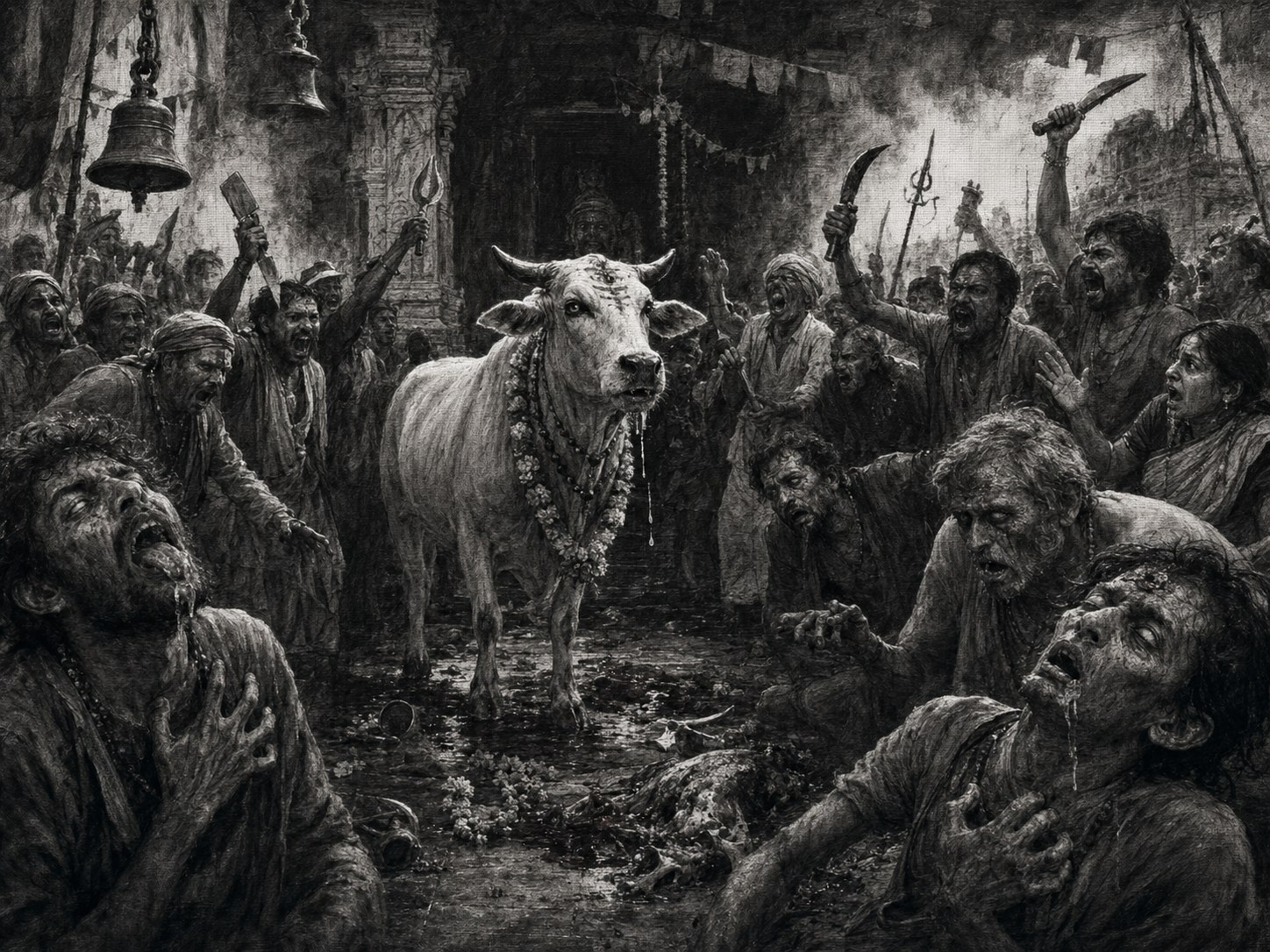
The cow belonged to no one and everyone, which in Calcutta is sometimes the most secure arrangement. She was large, pale, hump-backed, and decorated each morning by devotees with vermilion, marigold, and the vague bureaucratic compassion reserved for sacred animals and retired professors. The temple priest, Haradhan Bhattacharya, allowed her to stand beneath the banyan tree because her presence increased donations. Women touched her flank before exams, court dates, visa interviews. Men fed her bananas with the furtive tenderness they could not show their wives.
Her name, unofficially, was Gouri.
She had a torn left ear, intelligent eyes, and the patience of something that had seen empires become parking lots.
At nine-twelve that morning, as the temple bell rang and the smell of incense mixed with drains and frying kochuri, Gouri lifted her head from a heap of wilted spinach, chewed once, swallowed, and said, in a calm, broadcast-quality American accent:
“Ladies and gentlemen, I regret to inform you that there is no evidence for God.”
The lane went quiet in stages.
First the tea stall.
Then the flower sellers.
Then the temple courtyard, where a clerk from Dum Dum stopped mid-prayer, palms joined, mouth open.
Nirmal said, “What?”
Gouri turned her broad head toward him.
“There is, however, strong evidence that life on this planet emerged through chemical processes, likely involving self-replicating RNA molecules prior to DNA and protein-based cellular life.”
Her accent was not merely American. It was educated American. Soft r’s, clean vowels, a tone of patient public explanation, as if she had spent thirty years telling undergraduates that mitochondria were not decorative.
A woman dropped her puja plate. Marigolds fell into the mud.
Haradhan Bhattacharya came down the temple steps holding a brass lamp. He was a small, handsome man with a white thread across his bare chest and the exhausted dignity of a priest who had, by necessity, become half accountant, half event manager. Only last month he had installed QR-code donation stickers beside the idol. Faith, in modern Calcutta, had learned to accept UPI.
“What nonsense,” he whispered.
“It is not nonsense,” said Gouri. “It is introductory evolutionary biology.”
Someone laughed. The laugh died quickly.
Parimal felt, before fear, a shameful flicker of delight. He had spent years speaking to patients about cholesterol, insulin resistance, antibiotic misuse, and the heroic stupidity of stopping blood-pressure medicine because a neighbor’s cousin had recommended bottle gourd juice. Nobody listened. Now here was a cow, and a holy one, calmly delivering the RNA world hypothesis in an accent fit for a Massachusetts lecture hall.
He stepped closer.
“Who taught you this?” he asked.
Gouri looked at him.
“Language is a late convenience,” she said. “Hunger is older. Error is older still.”
Her eyes were wet and brown. There was nothing comic in them.
By noon, the video had reached Behala, Salt Lake, Howrah, Siliguri, Dubai, New Jersey, and three Bengali family WhatsApp groups in which everyone had already forwarded it twice with captions of increasing stupidity. HOLY COW SAYS NO GOD, wrote one. CIA CHIP INJECTED INTO TEMPLE ANIMAL, wrote another. END TIMES CONFIRMED, said a third, which belonged to Parimal’s maternal cousin who sold insurance and had once failed biology.
By one, a local news van arrived.
By two, police put up bamboo barricades.
By three, men with party flags appeared, though no one was sure which position would be electorally useful. The posters pasted on the walls behind them promised jobs, justice, English-medium futures, subsidized gas, and revenge. Rain loosened the glue. Faces of leaders slid down the walls with soft, tragic expressions.
Parimal stayed.
He told himself he stayed as a scientist. This was an event. Speech in a cow was impossible. American English in a North Calcutta stray was impossible in a more specific and personally insulting way. He watched Gouri answer questions with awful composure.
A young man in a saffron kurta shouted, “If there is no God, who created the universe?”
“The question may not survive the physics required to answer it,” said Gouri.
A grandmother asked whether her dead husband existed somewhere.
Gouri lowered her head.
“Memory is real,” she said. “Love is real while carried. That may be less than you want. It is not nothing.”
The grandmother began crying.
This was the trouble, Parimal thought. The cow was not mocking them. Mockery they could have handled. Calcutta knew what to do with mockery. It could mock back, form a committee, call a strike. But Gouri spoke with a devastating gentleness, as if removing illusions were a form of first aid.
Haradhan the priest stood beside Parimal under the pharmacy awning. Sweat ran down his temples despite the rain.
“You are science man,” he said. “Tell me this is some speaker.”
“I don’t see one.”
“Ventriloquist?”
“Cows do not have the vocal tract for this.”
“Then?”
Parimal said nothing.
Haradhan’s face tightened. “My son’s engineering admission fees depend on this temple. People think priests eat faith. We eat school bills, doctor bills, electricity bills. Same as everyone.”
It was the first honest thing anyone had said all day.
At five-thirty the power went out.
The lane darkened. In the old apartment balconies, in the sweet shops and the cheap cafés, in the diagnostic centers and coaching rooms, fans slowed and stopped. The city, deprived of electricity, became suddenly older. Rain tapped on tin shades. Somewhere a child cried. Somewhere a pressure cooker hissed like an animal warning others away.
Then Gouri said, “Do not be afraid of being animals. You have never been anything else.”
That was when the first stone struck her flank.
Not hard. A warning.
The thrower was a young man named Bappa, whom Parimal knew slightly. Bappa delivered medicines on a motorbike and attended evening classes in data analytics advertised as “AI Career Superfast.” His father had died during the second COVID wave after waiting eighteen hours for an oxygen bed. Since then Bappa had become the kind of young man who carried inside him a permanently loaded verdict, needing only a target.
“Shut up,” Bappa said.
Gouri turned.
“You are grieving,” she said.
Bappa picked up another stone.
By night, the crowd had changed texture. Day crowds have errands. Night crowds have permission. The rain stopped, leaving the lane slick and silver beneath emergency lights. More men arrived. Some had devotion painted on their foreheads. Some had hunger in their pockets. Some had merely seen a crowd and entered it, because loneliness in the city often disguises itself as public feeling.
A rumor spread that the cow had insulted the goddess.
Then that she had been fed beef by foreigners.
Then that her meat, if eaten, would cure disease because she had absorbed divine fire.
Contradictions did not bother anyone. People are not computers. They can hold opposing stupidities with the grace of trained dancers.
Parimal tried calling a veterinary college contact. No answer. He called the police station. Busy. He called a journalist he knew from his diagnostic days, who said, “Dada, can you get a clearer video? Horizontal, please.”
Haradhan had disappeared into the temple.
Gouri stood under the banyan tree. Her garland had slipped to one horn.
Parimal pushed through the crowd until he reached Bappa.
“Listen to me. This is a living animal. Also possibly the greatest biological anomaly ever recorded.”
Bappa laughed. “Biology? My father died because biology needed oxygen and there was none. Where was your science then?”
“In hospitals. In vaccines. In cylinders black-marketed by criminals. Don’t mix everything.”
“Everything is mixed, Dutta-da. That is the problem.”
He was not entirely wrong, which made him more dangerous.
The first cut was made by a butcher from the market who later insisted he had been forced, though no one had seen much reluctance. Gouri did not run. That was what Parimal would remember. Not the blood, though there was blood. Not the sound, though the sound entered him and built a small permanent room there.
He would remember that she looked at him while they tied her.
“Protein,” she said softly, her accent still perfect. “Be careful with it.”
He understood only later.
The police came after the killing, which is one of the dependable rhythms of civilization.
By then the sacred cow had become contraband meat. Pieces vanished into plastic bags, steel tiffin carriers, temple vessels, newspaper packets. Some claimed they took it for ritual disposal. Some for evidence. Some because meat was expensive and miracles rarer still. A few men cooked it that night in a back room behind the flower stalls with onions, garlic, chili, and a bottle of cheap rum. Bappa was there. Haradhan was there too, though he did not eat at first.
Parimal saw him through the half-open shutter.
The priest sat against the wall, his forehead wiped clean, staring at a plate.
“You too?” Parimal said from the doorway.
Haradhan looked up. His eyes were red.
“Tomorrow they will say I failed to protect dharma. Or that I hid divine flesh for myself. Either way I am finished.”
“So you eat?”
“So I belong to whichever story survives.”
There it was, Parimal thought. Respectability, that great Bengali household deity, demanding another small human sacrifice. Not belief. Not unbelief. The terror of being seen on the wrong side of the lane.
He went home without milk.
His mother was sitting in the dark, holding a steel glass.
“Pari?” she said.
“Yes, Ma.”
“The cow came?”
He froze.
“What cow?”
She looked toward the window where the rain had begun again, thin and needling.
“The one from your father’s village. The white one. It said not to boil the milk too much.”
His mother smiled, then forgot the smile.
Parimal slept badly.
By morning, the city had chosen its official version. The cow had been a hoax. Anti-national elements had used hidden speakers. No cow had been harmed. Anyone circulating violent videos would face legal consequences. The temple reopened after purification rituals. A municipal van came and washed the lane with bleaching powder. The blood thinned into pink threads and entered the drain, where Calcutta stores its secrets with democratic efficiency.
But Bappa did not arrive for tea.
On the third day, Nirmal said Bappa had fever.
On the fifth day, Bappa’s mother brought him to Parimal’s center because the government hospital line was too long and private neurology was impossible. Bappa walked in trembling, eyes wide, sweat running down his neck. He kept swallowing though there was nothing in his mouth.
“Dutta-da,” he said, “I can’t sleep.”
His right hand jerked.
Parimal checked his temperature. Mild fever. Pulse high. He asked about alcohol, drugs, head injury. Bappa denied everything. When Parimal touched his shoulder, Bappa flinched so violently the chair fell.
“Did you eat any of the cow?” Parimal asked.
Bappa’s mother gasped. “What are you saying?”
Bappa stared at the floor.
Parimal felt the old machinery of scientific dread begin turning. Not fear. Fear is fast. Dread is methodical.
He drew blood, though he knew blood would tell him nothing useful. He wrote a referral to neurology. He searched medical databases until three in the morning, reading about prion diseases, bovine spongiform encephalopathy, variant Creutzfeldt-Jakob disease, incubation periods measured in years, not days.
Years.
That was the mercy and the contradiction.
Bappa worsened in hours.
So did the butcher.
So did two flower sellers, a taxi driver, Haradhan’s assistant priest, and an elderly man who had taken home “holy meat” for his arthritic wife.
They did not all present alike. Some shook. Some laughed. Some became terrified of water. Some spoke in voices not their own. The butcher, strapped to a bed in R.G. Kar, recited the periodic table in a flat Midwestern accent though he had left school after class seven. A flower seller named Mina described nucleotide pairing to a neurologist and then bit her own tongue. The taxi driver kept asking for his mother in Spanish.
Haradhan came to Parimal on the seventh night.
The priest had not eaten the meat. That was the first thing he said.
“I swear.”
His hands trembled.
“But you served it?”
Haradhan closed his eyes.
“I watched.”
Outside, rain hit the shutters. The lane below was empty except for a dog worrying a paper plate. From somewhere came the recorded announcement of Shyambazar Metro, muffled by weather and distance, a woman’s voice naming stations as if order still existed underground.
Parimal poured tea into two cups.
“You must tell the health department everything.”
“They will arrest me.”
“Maybe.”
“They will say I killed a sacred animal.”
“You helped distribute contaminated tissue from an impossible cow.”
“Is that better?”
“No.”
Haradhan laughed once, without humor.
“What disease is this?”
“I don’t know. Prion-like, maybe. But too fast. Neurological. Transmissible through eating.”
“You can treat?”
“No.”
The priest looked smaller than his thread, smaller than his fear.
“Then why did the cow speak?”
Parimal had been asking himself the same question. He had recorded every video, enhanced audio, checked for edits, read until his eyes burned. He had found no answer. Only one detail troubled him more than the rest. Gouri had not said, “You evolved from monkeys,” the usual bazaar version of Darwin. She had spoken of RNA. Replication. Protein. Error. Hunger.
Not prophecy. Warning.
A week later, the first dead were burned quietly.
By then the infection had moved through households. Not by breath, not by touch, but by leftovers, by shared curry, by the practical tenderness of mothers feeding sons and wives saving portions for husbands returning late. Calcutta’s old virtue, the refusal to let food go to waste, became an accomplice.
Rumor outran the ambulances.
The disease acquired names. Gouri Fever. Holy Tremor. American Cow Madness. Some said it struck only unbelievers. Some said only believers. Some said the vaccine lobby had done it, though no vaccine existed. A television panel argued for forty-two minutes about cultural hurt while a neurologist tried, unsuccessfully, to explain protein misfolding between advertisements for fairness cream and luxury apartments in Rajarhat.
Parimal sent samples to labs using favors he had no right to ask. Cerebrospinal fluid. Tissue. Blood. He wrote careful notes. He stopped sleeping. He forgot to buy milk again and again.
His mother declined quietly, as if following a private map.
One night, during a power cut, she called him by his father’s name and asked why the cows were standing in the bedroom.
“There are no cows, Ma.”
“So many,” she whispered. “All looking.”
He turned on his phone torch.
For a second the room flashed white: the damp wall, the Godrej almirah, the plastic medicine box, his mother’s thin hands, the mosquito net tied up like a ghost at the bedpost.
No cows.
Only the smell of wet earth and something faintly sweet.
Then his phone played a video by itself.
Gouri stood beneath the banyan tree. Rain on her hide. Vermilion on her forehead.
“Protein,” she said. “Be careful with it.”
Parimal dropped the phone.
He had not opened the file.
By the fourteenth day, the city began eating less meat.
By the sixteenth, the government declared the situation contained.
By the seventeenth, a minister visited the temple and fed bananas to a different cow for cameras.
By the eighteenth, Haradhan hanged himself from the temple storeroom fan using a length of red cloth meant for decorating the goddess during puja. His note contained only three words in Bengali: I did not know.
Parimal read those words in a photograph sent by a constable who owed him money.
He wanted to feel anger. Instead he felt the vast tiredness that comes when blame spreads too thin to hold. Everyone had done a little. Everyone had believed a little. Everyone had looked away at the useful moment.
On the twenty-first day, Parimal received the lab report.
No known prion marker.
No bacterial pathogen.
No viral genome.
The tissue samples showed something stranger: abnormal protein aggregates wrapped around fragments of RNA, self-copying in vitro under conditions where they should have degraded. Not alive. Not dead. A molecular rumor teaching itself grammar.
At the bottom, the Delhi scientist had written in a private note: Where did you get this?
Parimal sat in his clinic after closing, the shutters down, the room smelling of spirit, dust, and old fear. He replayed the first video. Gouri’s calm face filled the screen. Behind her, half hidden in the crowd, stood Bappa, Nirmal, Haradhan, himself.
The cow said there was no evidence for God.
Not that there was no God.
He noticed the difference now.
His mother died that night in her sleep. Peacefully, the doctor said, because doctors use that word when no one has screamed. At dawn, while waiting for the hearse, Parimal went to the kitchen to make tea and found the milk packet on the counter swollen tight.
He had not bought milk in three days.
Across its plastic skin, in condensation, letters had formed.
Not Bengali.
English.
A neat, looping American hand.
WE SPOKE FIRST IN CATTLE BECAUSE YOU LISTEN TO WHAT YOU WORSHIP.
He stood there until the power returned and the fridge began humming with its small domestic certainty.
Then, from the lane below, beneath the waking cries of vendors and the first impatient horns of traffic, came the lowing of many cows.
Parimal went to the balcony.
Calcutta was filling with them.
White, brown, black, rain-slick, garlanded, wounded, patient. They stood at crossings and tea stalls, outside hospitals, beneath metro pillars, before gated towers, beside coaching centers, in market slush and temple courtyards. Delivery riders slowed. Buses stopped. People came out holding phones.
The nearest cow looked up at Parimal’s balcony.
When she spoke, her accent was not American.
It was his mother’s.
“Pari,” she said gently, “this time, write it down before they get hungry.”